


Five things you don't know about Puglia (and that will make you book before summer)
Most people start with the Puglia of trulli and orecchiette. There is another journey further east, along the Adriatic coast between Otranto and Porto Badisco, and some of the things you don't know about Puglia are there simply because they sit outside the usual itineraries. We have picked five. One can only be seen at dawn, and one cannot be seen at all; two tell their story in stone, and one ends up on the table. Knowing them in advance helps you choose your dates, because they do not all share the same season.
1. The sun rises here before anywhere else in Italy
Capo d'Otranto, home to the Punta Palascia lighthouse, is Italy's easternmost point. The Touring Club describes it as a natural bridge between the peninsula and the Balkans, and in practice that means one thing: the day begins here before it does anywhere else in the country. For centuries the whole Salento area was known as Terra d'Otranto. After New Year's Eve many people make their way to the lighthouse for the first sunrise of the year, but the moment is worth catching in any season. You arrive by car and finish on foot along a short dirt path, ideally with a torch if it is still dark. The outside of the lighthouse can be visited freely and the area is shared with military installations, so it is best to respect the signs. Masseria Panareo is a short drive away along the coastal road, and you are back in time for breakfast.
2. A “Sistine Chapel of Prehistory” you cannot visit
At Porto Badisco lies the Grotta dei Cervi, the Cave of the Deer. It was discovered on the night of 1 February 1970 by a group of cavers from Maglie, intrigued by a draught of warm air coming from a crack in the rock. At first it was christened the Antro di Enea, because tradition places the landing of the Trojan hero Aeneas at Porto Badisco. Inside they found almost three thousand Neolithic pictograms, painted with bat guano and red ochre along corridors stretching beyond fifteen hundred metres. Near the entrance there were also ceramic finds left as votive offerings, a sign that the place was used for ritual. The 1970-71 excavations were directed by Felice Gino Lo Porto, and the paintings were published by Paolo Graziosi in 1980. The sheer scale of the cycle has earned the cave the nickname “Sistine Chapel of Prehistory”. It remains closed to the public, because its delicate microclimate is what has preserved the pigments for millennia. It is an excellent reason to stop at Porto Badisco, and to read the full story in our article on the rock paintings.
3. Masserie were born out of fear
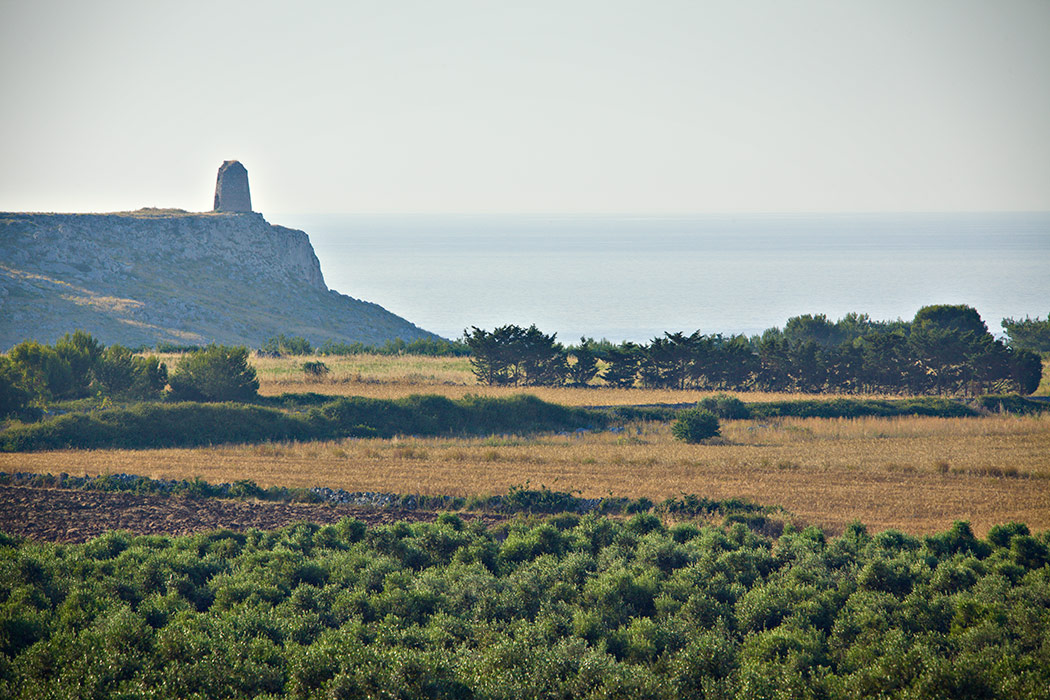
In 1480 the Turks took Otranto. As a FAI presentation on Salento's defensive system recalls, after that siege nothing was ever the same: the coasts became borders to defend, and coastal towers, tower-houses and fortified masserie appeared. In Otranto the Aragonese rebuilt the castle with bastions and round towers, and watchtowers multiplied along the coast: by the end of the sixteenth century, according to a study of Puglia's coastal towers, there were 379 of them across the kingdom. Behind many a masseria, then, stands a working farm with the defences of a small fortress, built to produce and to resist. Masseria Panareo reaches back further still: its website tells of medieval origins tied to Basilian monks and a Norman-era outpost against Saracen raids, before it became a rural residence in the eighteenth century. To see how that history led to today's hospitality, read our piece on the masseria as a form of civilisation.
4. A King Arthur on a cathedral floor
Otranto, the ancient Hydruntum founded by the Greeks, keeps the legacy left by Byzantines and Normans. Step inside its Cathedral, consecrated in 1088, and look down. The building stands on the remains of a Messapian village, a Roman domus and an early Christian temple, and its eleventh-century crypt has seventy-two columns with capitals in different styles. The floor is a single mosaic, the Tree of Life, made between 1163 and 1165 and attributed to the Basilian monk Pantaleone, commissioned by Archbishop Gionata. It has more than six hundred thousand tesserae, and among the branches you find Old Testament scenes, animals from medieval bestiaries, episodes from the Alexander Romance and figures from the chivalric cycle, including King Arthur. The Touring Club considers it the best-preserved mosaic in the region. It is a visit that does not depend on the weather, handy to keep for a windy day; opening hours should always be checked beforehand.
5. An olive mill underground, to light the lamps
For a long time, olive oil in Salento was made underground. The hypogeal mills, known as frantoi ipogei, were carved into the rock and, according to the most widely accepted accounts, between the fifteenth and nineteenth centuries they mainly produced lampante oil, meant for lighting rather than cooking. The subsoil kept a constant temperature, which helped extraction. In Gallipoli, according to a report in Quotidiano.net, there were thirty-five of them. In many villages, such as Specchia, they have been restored and can be visited at certain times of year; at Caprarica di Lecce, a Città dell'Olio since 2000, there are about ten. Masseria Panareo's history also mentions hypogeal mills, while today the extra virgin oil on the table is produced from the olive groves surrounding the property. From October to December guests can join the olive harvest with the “L'Oro del Salento” experience, which ends with a tasting of the new oil.
Why it pays to plan before summer
The five stories do not share a season. The sunrise works all year, the mosaic is visited during the cathedral's opening hours, the olive harvest runs from October to December and the Masseria's private boat tour operates from April to October. Thinking about dates early lets you fit them together without giving anything up, and choose the right month for the kind of trip you have in mind. Anyone who arrives with a calendar in hand soon realises that Salento does not have a single good season, but several. These five curiosities about Puglia are a starting point: if you want to begin with the calendar, the guide to the best time to visit Salento, month by month, is the next step.

When to Visit Salento: A Month-by-Month Guide to the Adriatic Coast
There is no single answer to the question of when to visit Salento: it depends on what you are looking for—warm seas, culture, food or tranquillity. The Adriatic coast between Otranto, Porto Badisco and Santa Cesarea Terme changes more throughout the year than you might expect, and every month has something to offer. Average conditions suggest June and September as the most comfortable months for swimming, but the sea is not the only reason to visit. This guide takes you through the year, month by month, with average weather conditions, confirmed events and the experiences offered by Masseria Panareo in each season. Of course, the figures are averages from weather services: they are intended as a guide, not a promise of what the weather will be like.
April to June: The Sea Warms Up Gradually
Spring and early summer are a time of transition. The sea takes a while to warm up: forecasts for Otranto indicate around 14°C at the end of March, while the June average rises above 22°C. If you want to swim comfortably, it is best to wait until June; if you prefer coastal walks and exploring the old town, you can come earlier. The Wom Travel identifies May to September as the best period for enjoying Otranto. At the masseria, the private boat tour “Tramonto sul Blu” (Sunset on the Blue) and the scooter tour are available from April to October, subject to sea and weather conditions.
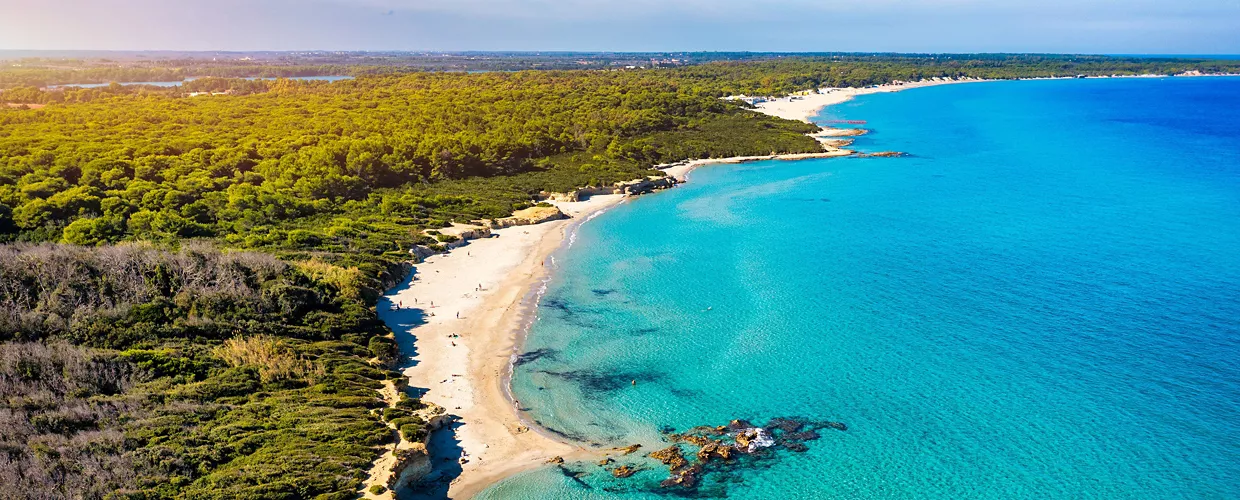
This is also the ideal season for places best explored on foot: the Cathedral with its mosaic, the Aragonese Castle and the paths leading towards Punta Palascia. South of Otranto, the coastline becomes high and rocky, with caves stretching all the way to Santa Maria di Leuca—a landscape worth discovering even while the sea is still cool. To decide where to begin your seaside explorations, our guide to the beaches and coves along the Otranto coast suggests some starting points. For families, the two most frequently recommended places are Baia dei Turchi, with its pale sand, gently sloping seabed and shady pine forest, and the Alimini beaches, which have received the Blue Flag award several times.
July and August: The Sea at Its Warmest
These are the peak summer months. August is generally the hottest month of the year, with highs of around 31–32°C, while July and August are among the driest. Average sea temperatures reach their highest levels, between 25°C and 27°C according to several weather services. It is also a season full of events, when Salento’s towns come alive with activities for every taste. To avoid the heat in the middle of the day, it helps to split your itinerary, as suggested in our guide to a day in Otranto with children: explore the town early in the morning and head to the beach in the afternoon.
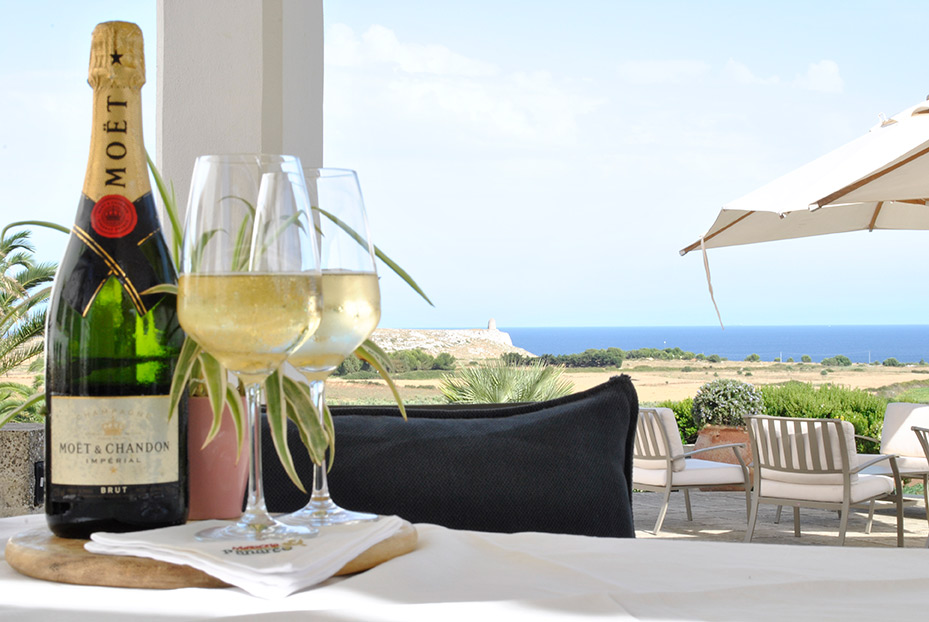
Evenings are best spent outdoors. During the warmer months, the masseria’s restaurant serves dinner in the courtyard, with views stretching towards the sea and the Torre di Sant’Emiliano. The restaurant also welcomes non-resident guests, so booking in advance is recommended.
September: A Month of Transitions
In September, the sea is still warm, at around 25°C according to measurements from recent years: August, July and September are the months with the warmest water. Meanwhile, Otranto’s calendar shifts from the beach towards the town. The autumn equinox falls around 22 or 23 September, providing a good excuse to get up at dawn and make your way to Punta Palascia.
October and November: The Season of New Olive Oil
In October, average daytime highs fall to around 22°C, while the sea remains at about 20°C—still warm enough for a swim if you do not mind cooler water. According to Beach-Weather.com averages, October is also the least windy month, with average wind speeds of around 12 km/h. From October to December, the masseria offers “L’Oro del Salento” (The Gold of Salento): hand-picking olives in the estate’s groves followed by a tasting of freshly pressed olive oil. November is generally the rainiest month, so the wine cellar, olive mill and kitchen become the focus of the day.
The restaurant occupies a former stable dating from the early twentieth century, with star-vaulted ceilings and local Lecce stone. The menu follows the seasons: in autumn and winter, legume soups and richer flavours take centre stage.
December to March: The Coast Out of Season
January is generally the coldest month, with highs of around 12–13°C, while sea temperatures fall to around 14°C in February. It is not swimming season, but the coast has plenty of other attractions: the old town, with its cobbled streets inside the Aragonese walls, can be explored at leisure. New Year in Otranto is associated with the Alba dei Popoli (Dawn of Peoples): after the celebrations, many people head to Punta Palascia to watch the first sunrise of the year in Italy. At the masseria, wine-cellar or olive-mill tastings, yoga and private dinners among the olive trees can be arranged throughout the year by reservation. Before planning a winter stay, it is advisable to check opening dates and availability.
How to Choose the Best Time for Your Trip
For swimming: June to September, when the sea is generally above 22°C. October is also an option for those who do not mind cooler water.
For culture and traditions: September, with its festival and sea celebration, or August for the Mercatino del Gusto food market in Maglie.
For food and olive oil: October to December, with the olive harvest and visits to the olive mill.
For peace and sunrise: the winter months, or any early morning at Punta Palascia.
If you would rather start planning with a little inspiration, read our article on five things you may not know about Puglia, all rooted in this same coastline. Then check availability for the time of year that appeals to you most.
Dinner in Otranto: the restaurant at Masseria Panareo, even if you're not staying
You don't need to book a room to sit down for dinner at Masseria Panareo. It's a common misconception: the Masseria is best known as a place to stay, but its restaurant is also open to anyone simply looking for a different kind of dinner near Otranto, without stopping overnight. And it's a stop worth considering on its own, regardless of the rest of the trip.
A dining room that stays with you
You eat in a setting that already tells its own story: a former stable from the early twentieth century, with star-vaulted ceilings and walls in Lecce stone, converted while keeping its original character intact. It isn't a room designed to look old: it genuinely is, and it shows in the light, the proportions, the way sound moves between the walls.
Dining al fresco, with the breeze and the Torre di Sant'Emiliano
In the warmer months, the restaurant moves outdoors, into the Masseria's courtyard: you dine with a view that reaches all the way to the sea and the Torre di Sant'Emiliano, cooled by the evening breeze. It's the kind of setting rarely found in a city restaurant, and one that alone justifies a detour from the beach for an evening.
A kitchen that follows the seasons, not a fixed menu
The menu at Masseria Panareo isn't static: it changes with the calendar, following the seasonality of ingredients the way it once was done. Hearty bean soups and warming flavours in autumn and winter, fresh vegetables and lighter dishes in spring and summer: guests who return at different times of year find, quite literally, a different table.
The ingredient that runs through every season is the extra virgin olive oil produced by the Masseria itself, from the centuries-old olive groves surrounding the property: not just any seasoning, but the recognisable thread running through every dish, alongside home-grown vegetables and produce sourced from small local producers.
When to book a table
As a property that also hosts overnight guests, booking ahead is particularly advisable, especially during the summer months and on evenings when dinner is served in the courtyard, where space is naturally limited by the masseria itself. It's the reasonable trade-off of a setting that was never meant to seat large numbers, but to remain an intimate experience.
More than dinner: an idea of hospitality
Having dinner at Masseria Panareo, even for just one evening, means stepping for a few hours into an idea of hospitality that goes beyond table service: the same care the Masseria reserves for its guests is extended, identically, to those who sit down for dinner without staying the night. It isn't a side experience meant only for hotel guests, but a restaurant that stands on its own, with its own identity, its own dining room and its own view of the sea.
For anyone on holiday in Otranto looking for dinner outside the town centre, or for those living nearby who want a special occasion without straying far from the coast, the restaurant at Masseria Panareo remains worth the detour, room booked or not.
Masseria: not a countryside hotel, but a form of civilization Puglia invented
Calling it a "countryside hotel" is convenient, but inaccurate. A masseria was born centuries before tourism, as the answer to a very concrete problem: how to live, work and defend oneself in a territory that was isolated, exposed and fertile all at once. Understanding this origin changes the way one walks through its walls today.
A name that comes from the land
The word masseria comes from the Latin massa, a cluster of farmland brought together under a single management. It didn't originally describe a building, but a system: land, labour and people organised around a centre. It's from this idea of a system, rather than of architecture, that one has to start to understand what a masseria really was before it became a form of hospitality.
1480 and the birth of the fortified masserie
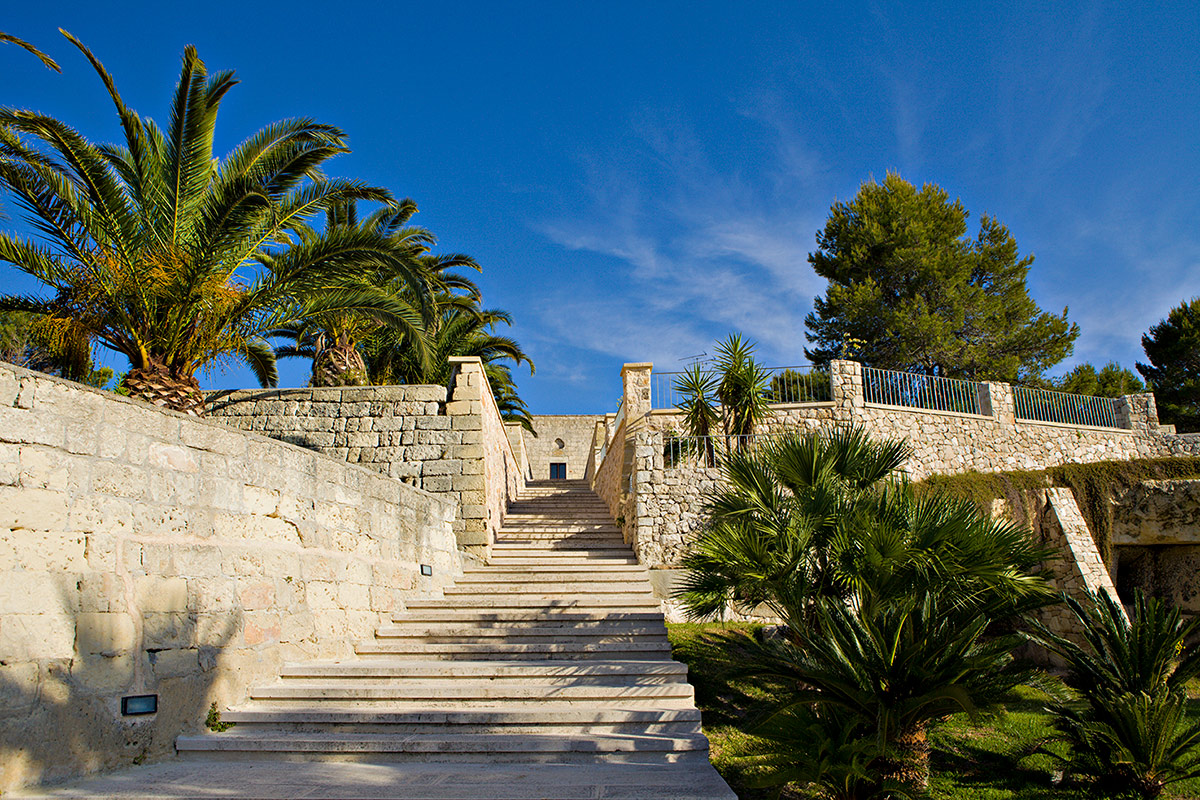
A single event permanently changed the character of these places: the siege of Otranto in 1480, when Ottoman troops landed on the Salento coast, spreading death and destruction. In its aftermath, the Spanish crown reinforced the entire Adriatic and Ionian coastline with a dense network of watchtowers and defensive towers. It was precisely those towers that became the original nucleus of most of Salento's masserie: courtyards, olive presses, stables and workers' quarters were gradually added around them, until they formed the fortified complex we still recognise today.
A small, self-sufficient world
Isolated in open countryside, far from urban centres, a masseria had to be self-sufficient. Inside its walls, oil was pressed in underground mills, grain was stored, livestock was raised, and life followed the rhythm of the seasons and the harvest. It was, in effect, a small autarchic fiefdom, in which production and protection were two sides of the same necessity. The central courtyard, a meeting point and a workplace, remained the beating heart of this productive cell.
Abandonment and rebirth
With industrialisation and the depopulation of the countryside, many masserie were left to decay for decades: walls that had withstood centuries of raids gave way, more slowly but just as surely, to neglect. It was only from the 1980s onward that a growing number of these structures found a second life, restored by families who recognised their value before they even grasped their tourism potential. Not a nostalgic recovery, but a way of inhabiting the present through memory.
Masseria Panareo, a history spanning centuries
The origins of the site on which Masseria Panareo stands, between Otranto and Porto Badisco, go back to the presence of Basilian monks, hermits who arrived from the East and carved prayer caves and crypts into the rock, traces of which still remain. In the Norman era the site became a defensive outpost against Saracen raids, gaining watchtowers and underground olive presses; in the eighteenth century the De Marco family turned it into a refined rural residence.
The more recent history is just as concrete: in 1987 Renato Zezza bought what was then a ruin set in the Salento countryside, on a promontory overlooking the Grotta dei Cervi. With his wife and children he transformed it into a small hotel, adding a restaurant and the Li Ficari farming business, later developed on adjoining land. In 2008 the property received the "Best Hotel in Italy" recognition from Unioncamere, as part of the Ospitalità Italiana award. Today Alessandro Zezza runs the hospitality side and the restaurant together with his mother, keeper of traditional Salento cooking.
Why choosing a masseria today means choosing a civilization
Sleeping in a masseria, before it's a matter of comfort, is a way of stepping inside a history that has survived sieges, neglect and rebirth without ever losing its centre: its relationship with the land. It isn't a stage set: it's the same architecture, built to defend and to produce, that today welcomes those looking for a different idea of holiday. Choosing a masseria like Panareo means choosing to stay, for a few days, inside this system of civilization that Puglia built over the centuries, not simply inside a room with a view of the olive trees.
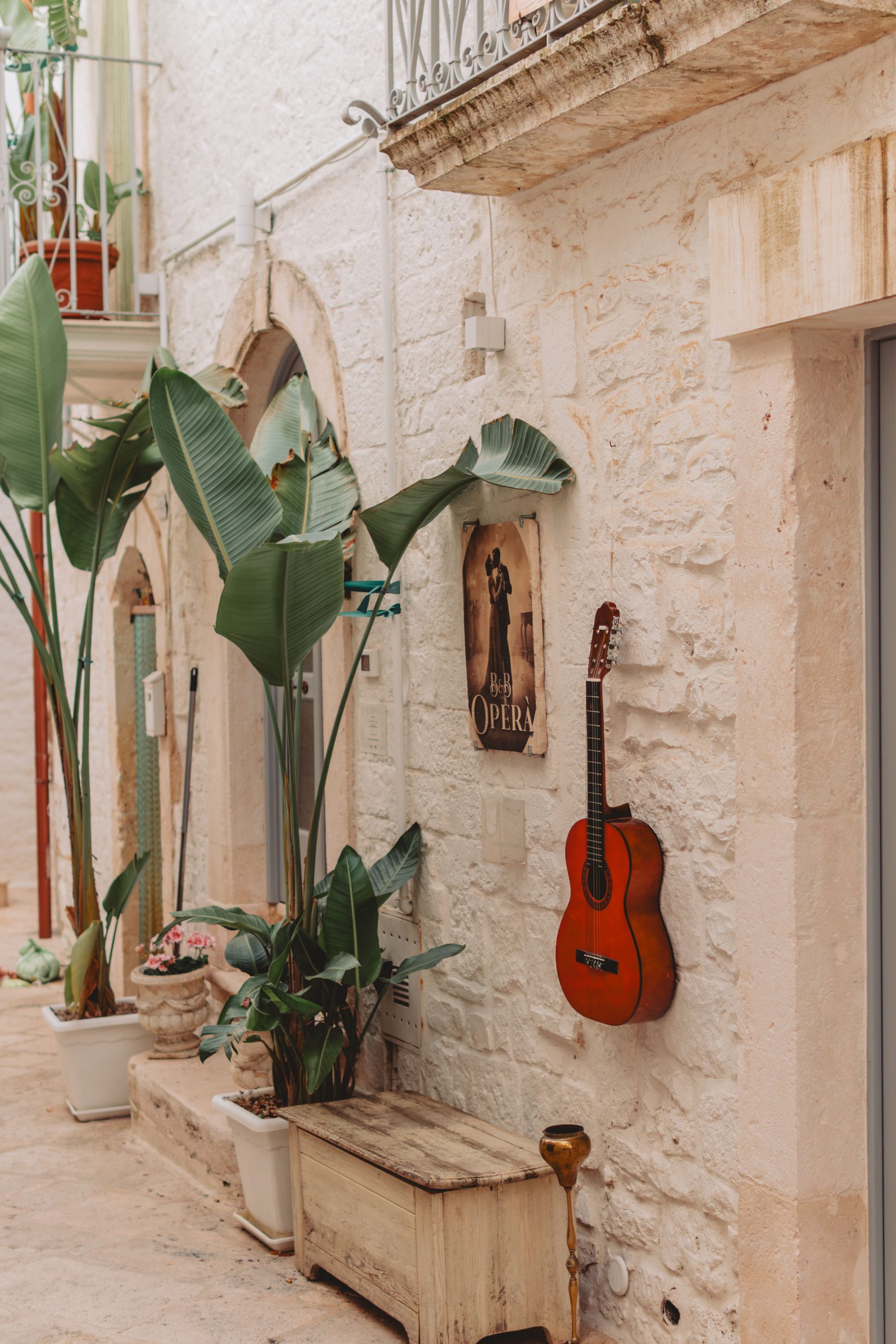
A day in Otranto with kids: what to do between the old town and the sea
Otranto works well with children, as long as you don't try to "finish" it in a single day. The old town is compact, the harbour is a short walk from the historic centre, and family-friendly sea is never far away: a combination that lets you alternate stone and water without long car journeys, the real enemy of any day out with young children.
Start early, without rushing
Otranto's old town is mostly flat, but between cobblestones and the occasional step, a light stroller, or a baby carrier for the smallest ones, remains the most practical choice. It's worth starting the visit in the cooler morning hours, leaving the beach for early afternoon: this order is less tiring and leaves children with enough energy for the last stop of the day, almost always their favourite.
The Aragonese Castle, moat and towers
The natural first stop is the Aragonese Castle, also known as Forte a Mare: built at the end of the fifteenth century and reinforced in the one that followed, it has a pentagonal layout, a moat and thick walls that offer some relief from the summer heat. For children it's easy to turn into a game of towers and walkways, with little explanation needed: the walls speak for themselves.
The Cathedral and the Tree of Life
A short walk away stands the Cathedral of Santa Maria Annunziata, dating from the eleventh century, home to one of the most striking mosaic floors in southern Italy: a large Tree of Life populated by animals, figures and scenes that capture children's attention more than one would expect from a church. There's no need to know its symbolism to be intrigued by it, just look down instead of up, as one usually does.
A pause at the harbour, boats and gelato
The harbour promenade is smooth, dotted with benches, and it's the right spot for a break: watching the fishing boats come and go keeps younger children occupied as well as any structured activity would. It's also the natural moment for an ice cream, before heading back into the old town's lanes for one last stroll among the shops.
The afternoon at the sea: Baia dei Turchi and Alimini
For the sea, two names come up more than any others when it comes to families: Baia dei Turchi, with pale sand, a gently sloping seabed and a pine forest that provides natural shade, and the Alimini beach, repeatedly awarded the Blue Flag, with shallow water and fine sand suited even to younger children. Both offer a choice between free stretches of beach and equipped beach clubs, depending on how much service you want during the day.
Back to the masseria: a slow evening
Guests staying at Masseria Panareo, between Otranto and Santa Cesarea Terme, can close the day without the background noise of high season: the garden among the olive trees and the panoramic pool leave children room to run around a little longer, while the adults recover their own pace. It's the most natural way to stretch, even by just an hour, the energy of a day well spent.
You don't need a rigid schedule to enjoy Otranto with children: a few well-chosen stops, a pace that respects the heat and the tiredness, and a comfortable base to move from without rushing, are enough.

Mercatino del Gusto di Maglie 2026: Flavours, Encounters and Culture in the Heart of Salento
There are evenings, in Salento, when a town's historic centre stops being a simple network of streets and becomes a route to wander at leisure, pausing wherever the scent leads. This happens in Maglie every year at the start of August, when the Mercatino del Gusto turns streets, squares and courtyards into a diffuse itinerary of food, wine, craftsmanship and music. For anyone staying on the Salento Adriatic coast, between Otranto and Santa Cesarea Terme, devoting an evening to this event adds a different chapter to the trip: no longer just the sea, but Puglia told through what it produces, cooks and preserves.
Twenty-Seven Years of a Market Turned Story
In 2026 the Mercatino del Gusto reaches its twenty-seventh edition, running in Maglie from 1 to 7 August. Over nearly three decades the event has grown from a simple food fair into an appointment capable of drawing hundreds of thousands of visitors across the week, with around a hundred exhibitors spread through the town's historic centre. It is not a market in the traditional sense: it is more of a narrative device that stages, every summer, the way Puglia interprets its relationship with food, craftsmanship and conviviality.
"Collaboration", the Thread Running Through the 2026 Edition
Every edition of the Mercatino chooses a guiding word around which to build its programme. For 2026 the chosen word is "Collaboration", a concept reflected in the event's international outlook: it continues the path begun in 2025 with the Chamber of Commerce of the Greek city of Arta, in Epirus, which returns to Maglie with its own delegation of producers and a dedicated space for traditional Greek products. It is a detail that captures the spirit of the Mercatino well: not an event closed in on its own territory, but a place that widens its boundaries while staying true to its Apulian identity.
A Walk Through Streets, Squares and Courtyards
Walking through Maglie during the Mercatino means letting yourself be guided by scents more than by a map. The streets of the historic centre become a sequence of stops: workshops and courtyards turn into small tasting spaces, producers talk about their own work first-hand, and the squares fill with live music and moments of encounter. It is an experience built step by step, with no set route, and it is precisely this freedom that makes it ideal for an evening without the rigidity of a minute-by-minute programme.
This is not an event meant to be rushed through. Anyone who arrives thinking they will "see it all" in a couple of hours almost always ends up staying much longer than planned, drawn in by a stall they had not accounted for or a square where the music invites them to sit a little longer. It is in this stretching of time, more than in the number of stalls visited, that the quality of the evening is measured.
The Taste of Speed: Where the Table Meets Design and Formula One
Among the confirmed initiatives for the 2026 edition is the exhibition "Il gusto della velocità: A Journey Through Food, Design and Formula 1", hosted at Maglie's Civic Museum of Palaeontology and Palaeoethnology from 1 August to 31 October. Curated by architects Cintya Concari and Roberto Marcatti together with sports journalist Umberto Zapelloni, the exhibition explores the connection between food culture, Italian car design and Formula One, under the patronage of the Order of Architects of the Province of Lecce. The opening was attended by the Scuderia Ferrari Club Galatone, with a display of vintage cars in the area in front of the museum. It is an example of how, in recent years, the Mercatino has chosen to pair its culinary dimension with a broader reflection on Italian production and cultural identity.
The Sound of Salento Jazz
The evenings of the Mercatino are accompanied by the bands of Salento Jazz, who bring music to various points of the historic centre with a soundtrack designed to accompany the walk between the stalls without ever overpowering it. It is a detail that says a lot about the character of the event: music as the backdrop to a shared experience, not as an attraction in its own right.
Planning the Visit from Otranto
Maglie lies inland in Salento, not far from the Adriatic coast: reaching it by car from Otranto and the surrounding towns is straightforward, though on Mercatino evenings it is worth allowing a few extra minutes for parking, given the number of visitors converging on the historic centre. A comfortable pair of shoes is the real accessory for the evening, far more useful than any printed programme: the Mercatino is meant to be experienced on foot, stopping, doubling back whenever a scent calls you back.
It is worth arriving with some time to spare before sunset: the early evening hours, while the historic centre is still filling up, make it easier to get your bearings along the main streets before the crowds reach their peak. Those who prefer a quieter pace can choose one of the earlier evenings of the week, generally less crowded than the weekend, keeping intact the diffuse atmosphere that sets the Mercatino apart from a typical village festival.
An Event That Tells the Story of Contemporary Puglia
Reducing the Mercatino del Gusto to a series of tastings would mean missing its deeper meaning. This is an event that, edition after edition, stages the way Puglia reinterprets its productive identity: not only through food, but also through design, music and, as this year's chosen theme shows, the ability to open up to other cultures without losing its own voice. It is an event that speaks as much to those looking for a good glass of wine as to those curious to see how, year after year, this land's story of itself keeps changing.
An Evening in Maglie Within a Stay on the East Coast
Guests staying at Masseria Panareo, between Otranto and Santa Cesarea Terme, can build a two-speed day around the Mercatino: the slow rhythm of the coast until late afternoon, followed by the livelier pace of Maglie's historic centre in the evening. There is no need to choose between the sea and the hinterland: they are two faces of the same Salento, and it is precisely in the shift from one to the other that the variety of this territory comes through. Returning to the masseria at the end of the evening, still carrying the scent of the historic centre, is the most natural way to close a day that has crossed two different souls of Puglia.
The Mercatino del Gusto is not an attraction to tick off an itinerary: it is a way to understand, in just a few hours, how Salento keeps telling its story through food, craftsmanship and encounter. For those looking for a base from which to experience it at their own pace, the coast between Otranto and Porto Badisco remains the ideal point of balance between the sea by day and discovery by night.
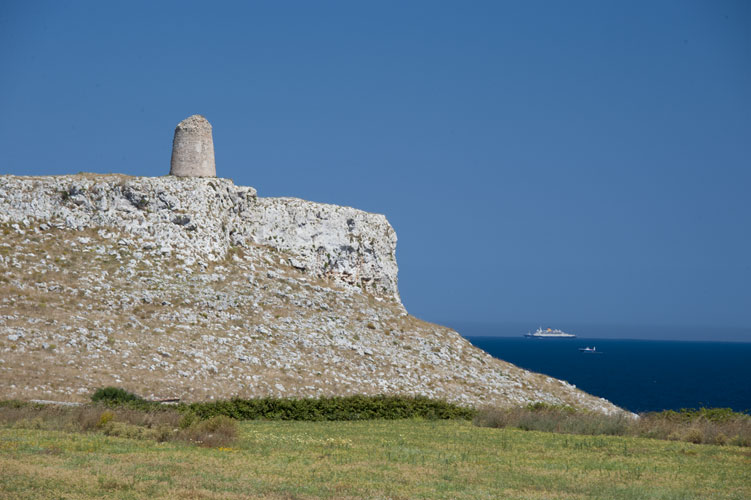
September in Otranto: The Month of Thresholds, from First Light to the Rituals of the Sea
Do not come in September to do at a slower pace what you would have done in August. Come to experience an Otranto that does not reveal itself the same way in August. On this coast, September is not a fading summer: it is a month of thresholds, the point where summer and autumn meet without colliding, where the day begins earlier and the evening stretches differently. It is the month when Salento stops chasing the season and starts telling its own story.
First Light: Starting the Journey from the East
On this coast, the day seems to begin earlier than elsewhere. Punta Palascia, the easternmost point in Italy, is the place to go looking for it. It is reached by car along the coast road connecting Otranto to Santa Cesarea Terme: a small free car park along the road, near the Navy base, leads to a short dirt path that in a few minutes brings you to the lighthouse, through Mediterranean scrub and the first light over the Otranto Strait.
The outside of the lighthouse can be visited freely at any time; access inside, when available, is subject to an entrance fee and seasonal opening hours worth checking on site. The area is shared with military installations, so the rule is simple: respect the signage and do not approach if access is cordoned off.
In 2026 the autumn equinox falls on 23 September, at around two in the morning, Italian time: the exact instant when day and night are equal everywhere on the planet. There is no need to treat it as an astronomical appointment to chase; it is enough to know that around these days the light shifts angle and the morning stretches out differently than it did in August. Anyone who sets off before dawn for Punta Palascia and then returns to the masseria for breakfast comes home with an image that rarely matches an ordinary summer's.
Otranto as a Mediterranean City
Once the morning by the sea is over, Otranto reveals another identity: not just a seaside destination, but a frontier town, long a place of encounter and observation of the Mediterranean. From 1 to 4 September 2026, the historic centre hosts the eighteenth edition of the Mediterranean Journalists' Festival, at Largo Porta Alfonsina: four days in which journalists, analysts and institutional representatives discuss information, geopolitics and the challenges of the Mediterranean basin, with the "Caravella del Mediterraneo" prize awarded on the closing night.
You do not need to be an insider to enjoy the Festival's evenings: it is enough to let yourself be drawn in by a debate before heading off to dinner in the old town. The contrast is part of the experience: mornings by the sea, afternoons among the lanes of the historic centre, evenings in a square discussing the present state of the Mediterranean, with the Cathedral and the Aragonese Castle in the background.
The Ritual of the Sea
There is a moment, every September, when Otranto stops being just a holiday destination and becomes itself again: the Festa della Madonna dell'Altomare, traditionally celebrated on the first Sunday of the month. The statue of the Virgin, kept in the small church overlooking the sea in the Punta area, is carried by fishermen down to the harbour, where a fishing boat receives it for the procession out to sea, escorted by a flotilla of boats.
During the procession, a wreath is cast into the water in memory of those who have lost their lives at sea: a gesture that speaks, better than any description, of the deep bond between Otranto and its sea. At dawn, the sea is a horizon to be reached. During the ritual, it becomes memory, work and collective identity for a community that has always lived by fishing and seafaring. It is worth experiencing with respect, the way you would a family celebration you have been invited to: not as a photo opportunity, but as a moment of participation in something that predates tourism by many decades.
September Evenings
As the summer crowds thin out, Otranto's evenings change pace. The seafront and historic centre stay lively with traditional Salento folk music performances and antiques and vintage markets, which on September weekends offer a more intimate alternative to the height of summer: quieter squares, longer conversations, a slower pace through the streets. The schedules for these events vary from year to year, so it is always worth checking the latest dates on the Comune di Otranto's official channels before planning the evening.
It is on these evenings, more than in August, that you feel the less fragmented sense of time that comes with choosing the low season: a dinner that is in no hurry to end, a walk that does not have to fight the crowds, a small market you can browse without the background noise of high season.
From Sea Salt to Soil
As September moves on, the coast's story gives way to that of the hinterland: vineyards, centuries-old olive groves, wine cellars and oil mills that hold the other half of Salento's identity. The Masseria offers a private tasting in its cellar or oil mill, available year-round: a guided journey through the secrets of winemaking and Apulian extra-virgin olive oil, ending with a tasting of three wines or oils alongside local specialities.
Those who extend their stay into October will find a further seasonal chapter: from October to December, the Masseria offers "L'Oro del Salento", a hand-picking olive harvest experience in the estate's own groves, followed by a tasting of freshly pressed oil with warm bread and local wine. It is a genuinely seasonal experience, one that does not anticipate the grape harvest but rather the first true ritual of the Salento autumn on the land: the olive harvest.
Three Ways to Experience September on the East Coast
The September of Light
For those seeking quiet more than movement: dawn at Punta Palascia, the equinox landscape, slow walks through the Mediterranean scrub, breakfast at the masseria with no set time.
The September of the Mediterranean
For those who want to stay tuned in: Otranto's historic centre, the talks at the Mediterranean Journalists' Festival, the ritual of the Madonna dell'Altomare, evenings in the old town filled with music and markets.
The September of Flavours
For those who travel through the table: the cellar or oil mill tasting, the Masseria restaurant's Salento cuisine, and, for those staying until October, the olive harvest and the new season's oil.
There is no need to choose just one September: in most stays, these three ways naturally intertwine, following the mood of the moment more than a rigid schedule.
Calm Seas or Wind: Two Possible Salentos
September also brings less predictable days, and this is exactly where the variety of this territory shows, more than its luck with the weather. With calm seas, the private boat tour "Tramonto sul Blu" remains available until October: departing from Otranto's harbour for a cruise along the coast to discover caves and coves, with an aperitivo on board, always subject to the day's sea conditions.
With wind or rougher seas, Otranto's historic centre offers an equally rewarding alternative: the Aragonese Castle, the Cathedral with its famous mosaic floor, and the workshops of the old town. On a cooler day, a visit to the cellar or oil mill becomes the perfect excuse for an afternoon indoors, among the flavours of the hinterland. On a clear morning, the choice returns to first light at Punta Palascia, the moment when Salento shows itself in its most essential form.
Masseria Panareo, Base Camp for September and October
Overlooking the coast road between Otranto and Santa Cesarea Terme, among centuries-old olive trees and Mediterranean scrub sloping down to the sea, Masseria Panareo is the ideal base from which to explore the Salento Adriatic coast without the constraint of daily travel: Otranto, Porto Badisco, Punta Palascia, Santa Cesarea Terme and Castro are all within easy reach along a short stretch of coastal road.
The rooms, with their vaulted ceilings and exposed stone, capture the atmosphere of a carefully restored fortified estate; the panoramic pool, overlooking the olive groves and the sea horizon, is the perfect place to spend the hottest hours of the day; the in-house restaurant serves a cuisine that combines local ingredients with traditional Salento recipes, reworked with a light touch. The stay becomes an integral part of the journey itself, not just a base to return to: a day on the east coast begins with the light and closes, in the evening, with a return to the olive groves and the quiet of the countryside.
September and October in Otranto ask you to give up nothing of summer: they simply ask you to look at it from a different angle, slower, closer to the land and sea that surround it. It is in this passage, between first light and the rituals of the sea, that off-season Salento finds its voice.
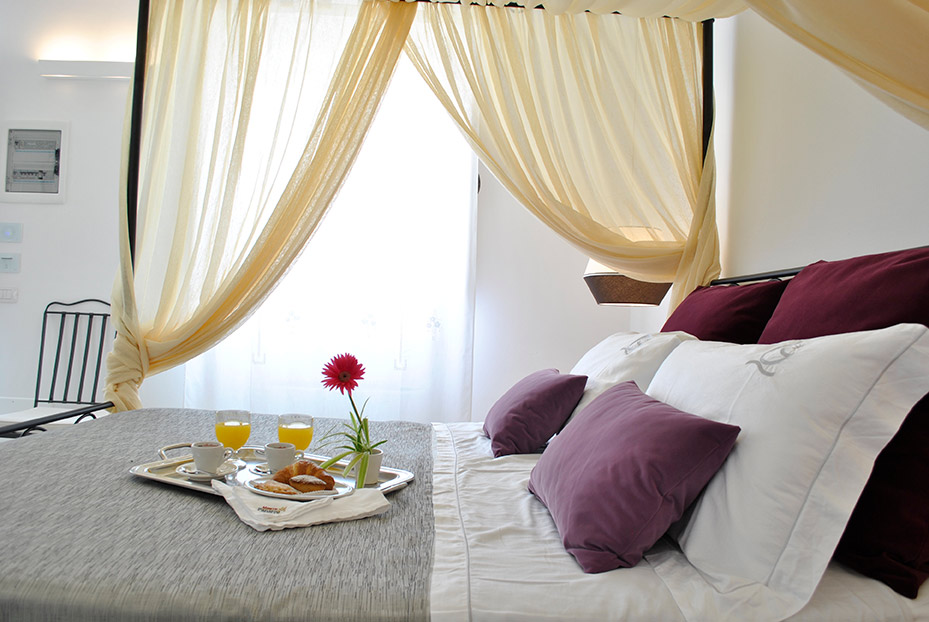
Romantic Breaks in Puglia: Salento for Two at Masseria Panareo
There is a way of travelling as a couple that has nothing to do with the catalogue-romantic package — rose petals on the bed, complimentary prosecco, ambient music drifting down the corridor. That approach works for some, but it tells a story of romance that belongs to someone else. The romance that Salento offers is something different: it is made of light, of silence, of ancient stone that absorbs the warmth of the day and releases it at night, of a table laid outdoors as the sky gradually darkens.
The most memorable romantic breaks in Puglia — the ones still spoken about years later — rarely come from five-star wellness resorts. They come from places with a character of their own, places that exist on their own terms and draw you into their story rather than constructing an experience around you. Masseria Panareo, 8 km from Otranto, inside the Otranto-Leuca Natural Park, is one of those places.
Why Puglia is Italy's Most Romantic Destination
Italy has romantic destinations everywhere. But Puglia — and Salento in particular — has something the others do not: scale. The distances are human, the landscape does not overwhelm, the light is never harsh. Limestone cliffs, a sea that shifts from deep green to turquoise without warning, whitewashed villages that look painted, farmhouses scattered across the countryside like kept promises: everything here builds an environment in which a couple, almost without noticing, slows down.
There is no Positano-style crowd. There is no performing luxury of the Amalfi Coast. There is instead something rarer: authenticity — that feeling, hard to describe and instantly recognisable, of being somewhere real, somewhere that was not staged for your benefit.
Masseria Panareo: Romance Without Artifice
Location: inside the park, close to the sea
Masseria Panareo stands on a limestone plateau surrounded by olive groves, 8 km from Otranto and 3 km from Porto Badisco. From the property you can see the Torre di Sant'Emiliano, a 15th-century coastal watchtower above the Adriatic. It is not a constructed view: it was already there before the masseria existed, and it is there every morning when you open the shutters.
The property sits inside the Otranto–Santa Maria di Leuca Regional Natural Park. The coastal paths start on foot from the masseria — an early-morning walk through Mediterranean scrubland and along the clifftop, with the sea alongside you the whole way, is the kind of romantic start to a day that no room-service menu can replicate.
The rooms: Lecce stone, silence, light
The guest rooms at Masseria Panareo are housed in the original historic building: star-vaulted ceilings in Lecce stone, handmade terracotta floors, solid-wood furniture. Puglian rural architecture at its finest — spare, cool, with that quality of quiet that belongs to spaces built to last. No decorative misfire, no concession to rustic-for-show.
Couples wishing to choose the room most suited to their stay — type, view, aspect — will find every option described on the Masseria Panareo rooms page.
The pool: sunrise over the Adriatic
The panoramic pool faces east, towards the sea and the watchtower. In the early morning — Punta Palascia, a few kilometres away, is the point from which Italy's first sunrise is seen — the light from the Adriatic turns the water pink. It is the moment when the pool belongs entirely to the couple who woke early, and the only sound is the wind in the olive trees.
The restaurant: the most authentic romantic dinner in Salento
The restaurant occupies the former stables, with stone-vaulted ceilings and well-spaced tables that ensure a level of privacy rarely found elsewhere. The menu is built around local ingredients — wild chicory, broad beans, frisella, extra virgin olive oil from the estate's trees, Primitivo and Negroamaro wines from local producers.
Dinner in a masseria is not a service: it is a story. Every dish has a precise provenance, a producer, a season. The Masseria Panareo restaurant changes its menu according to what the territory offers. For couples dining on-site, the need to drive in the evening disappears entirely — a practical detail that, in high-season Salento, is anything but minor.
What to Do as a Couple at and around Masseria Panareo
Sunset walk to Porto Badisco. 3 km from the masseria, the small limestone bay that tradition associates with Aeneas' landing. Nearly deserted in the early morning and late afternoon. The water is a shade of turquoise that does not belong to the usual Adriatic imagination.
Torre Sant'Emiliano coastal trail. The most spectacular path in the Otranto-Leuca Park, walkable on foot directly from the masseria. Cliffs, fossil coral reef, the sea below. An hour of slow walking, with an uninterrupted horizon.
Otranto at dusk. 8 km away, Otranto's old town is at its most beautiful in the evening, when the day-trippers have left and the low-angled light falls across the white stone of the lanes. The Aragonese Castle and the Cathedral with its 12th-century Norman mosaic pavement — one of the largest in Europe — take on a different weight with the right person beside you.
An evening at the Valle d'Itria Festival. Around an hour's drive away, Martina Franca hosts one of Italy's most important opera festivals every summer. An opera in the courtyard of Palazzo Ducale — in 2026, the bill includes Carmen in Bizet's original 1874 version, in its world premiere staging — is one of those evenings you carry with you for years.
When to Go: the Best Season for a Romantic Break in Salento
Spring (April–June). The most underrated season. The maquis is in flower, temperatures are perfect, the sea begins to warm. The masseria is quiet, the trails empty, prices below high season. You have the territory almost to yourselves.
July–August. High season, maximum atmosphere. The sea is at its best, the evenings are long, the Valle d'Itria Festival brings opera to Martina Franca. Requires advance booking but delivers the most intense experience.
September–October. The connoisseur's choice. The sea is still warm, the coastal paths are nearly empty, the light has that oblique golden quality only autumn Salento can provide. The new olive oil arrives in November, bringing a change of rhythm to the masseria's kitchen.
FAQ — Frequently Asked Questions for Couples
Is Masseria Panareo suitable for a honeymoon?
Yes. The property offers rooms in a historic building, a panoramic pool, farm-to-table restaurant and a natural park setting that ensures silence and privacy. It is one of the most sought-after choices for couples' stays in Salento.
Does Masseria Panareo have a private beach?
The property does not have a private beach. Porto Badisco, one of the most beautiful coves on the Salentine coast, is 3 km away. The elevated position gives panoramic views of the sea from the rooms and the pool.
Can we dine at the masseria without needing a car?
Yes. The restaurant is on-site. For couples who want to spend the evening without driving, it is the ideal option.
How far is Masseria Panareo from Lecce?
Around 45 km, approximately 40–50 minutes by car. Lecce is comfortably reachable for a day trip and is one of the classic pairings with a masseria stay.
Is Masseria Panareo open year-round?
Opening periods vary by season. We recommend checking directly with the property for availability on your preferred dates.
Plan your romantic escape to Masseria Panareo
8 km from Otranto, inside the Natural Park, with views over the Torre di Sant'Emiliano. Lecce-stone rooms, panoramic pool, farm-to-table restaurant.
Check availability
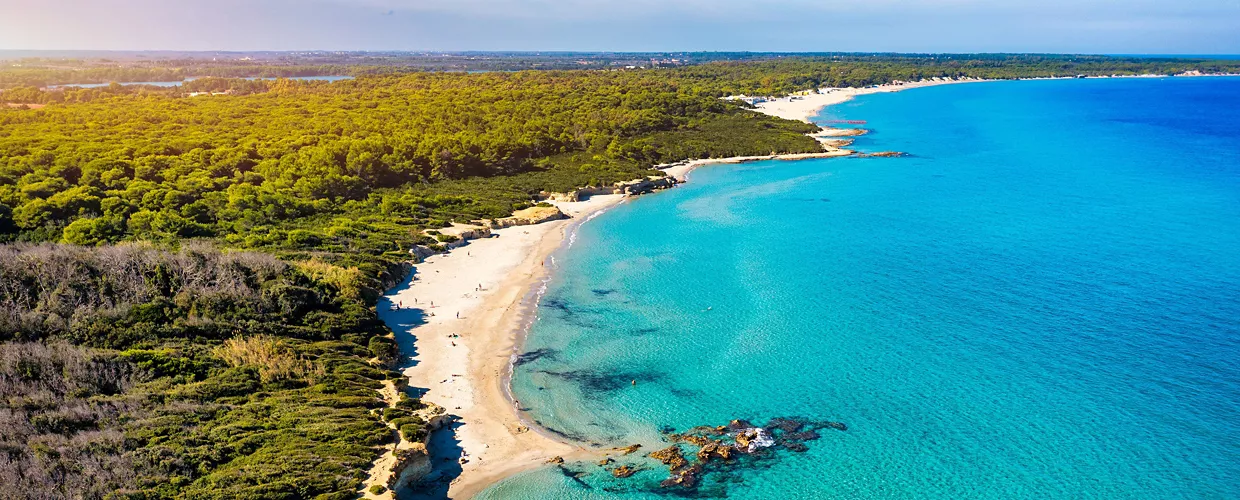
Waiting for Summer: The Most Beautiful Beaches and Coves Along the Otranto Coast
There is a moment, somewhere towards the end of winter, when the mind begins to pack its bags before the body does. You find yourself scrolling through photographs, tracing coastlines on a map, imagining mornings of sunlight and cold water. If that imagined place is the Salento — and more precisely the coast around Otranto — then this piece is for you.
The Salento peninsula has the rare privilege of facing two seas, but it is the Adriatic, along the stretch that unfolds north and south of Otranto, that holds some of Italy's most extraordinary coastal scenery: silent coves, fine sandy beaches, low limestone cliffs, fragrant pine forests. A variety that surprises even those who think they already know Salento well.
The Alimini Lakes: Where the Sea Meets the Lagoon
A few kilometres north of Otranto, the coastline changes character. The beaches at the Alimini Lakes open onto a setting of exceptional natural beauty: two coastal lagoons separated from the Adriatic by a thin strip of dunes and Mediterranean scrubland. The water is shallow and brilliantly blue, the sand is fine, and the pine forest behind provides welcome shade in the midday heat.
It is one of the most visited stretches of the Salento coast, yet it manages to retain a quality of natural beauty that is increasingly hard to find. Arriving early in the morning, when the light of dawn catches the surface of the lagoon, is an experience worth waking up for.
Baia dei Turchi: The Wildest Beach
A short distance to the south, Baia dei Turchi is one of the most loved and carefully protected stretches of the Salento coastline. Accessible only on foot through a pine-forest path, this bay of white sand and crystal-clear water takes its name, according to local tradition, from the Ottoman landings of the sixteenth century. Today it is a place of silence and unspoiled beauty.
Access is regulated during high season to protect the environment — reason enough to visit in early or late summer, when the light is softer and the crowds thinner. Bring water and something to eat: there are no facilities nearby.
The Beach at Otranto: Beside the Old Town
The beach at Otranto is something different. Not an isolated cove, but a stretch of urban coastline with the Aragonese Castle rising above the promenade and the historic centre almost touching the water's edge. Fine sand, shallow water suitable for children, beach clubs and long free sections: the ideal beach for those who want to combine sea and town in a single day.
It is worth spending at least one morning swimming here, then walking up into the city to visit the cathedral — with its extraordinary twelfth-century mosaic floor — and the walls of the old town. Otranto has much to offer beyond the beach.
Orte: A Quiet Cove
Heading south, the landscape shifts again. The coast grows rockier, the colours more intense. Orte is a small cove tucked between limestone outcrops — less known than the main beaches, and for that reason capable of offering a peace that is increasingly rare. The water is green and transparent, shallow close to shore. Perfect for snorkelling or simply floating in silence.
Porto Badisco: The Last Cove Before the Cape
Not far from the southernmost tip of Salento, Porto Badisco is a small natural bay enclosed by high cliffs. Local tradition holds that this is where Aeneas landed after fleeing Troy — legend or history, the place has an atmosphere entirely its own.
Parking is close and access easy, but the beach is small and fills quickly. Arriving in the early morning, or in the late afternoon when the low-angled light turns the cliffs golden, is well worth the effort. Nearby, the Grotta dei Cervi is one of the most significant prehistoric cave systems in Europe.
Building Your Days: The Right Pace for the Salento Coast
Salento is best enjoyed without a schedule. One beach per day, or perhaps fewer: what matters is staying long enough to feel the rhythm of the place. A morning by the sea, a light lunch in the shade, a slower afternoon — and then, in the evening, the drive back to the masseria.
Masseria Panareo sits in the countryside near Otranto in a position that makes all of these destinations reachable within a few minutes. A quiet base, set in the Apulian landscape, from which to set out each morning and return each evening with the honest tiredness of a day well spent.
The sea of Salento is also made of this: of setting out and coming back, of discovery and rest. And the masseria, in this rhythm, is not just a place to sleep. It is the slower, more essential part of the journey.
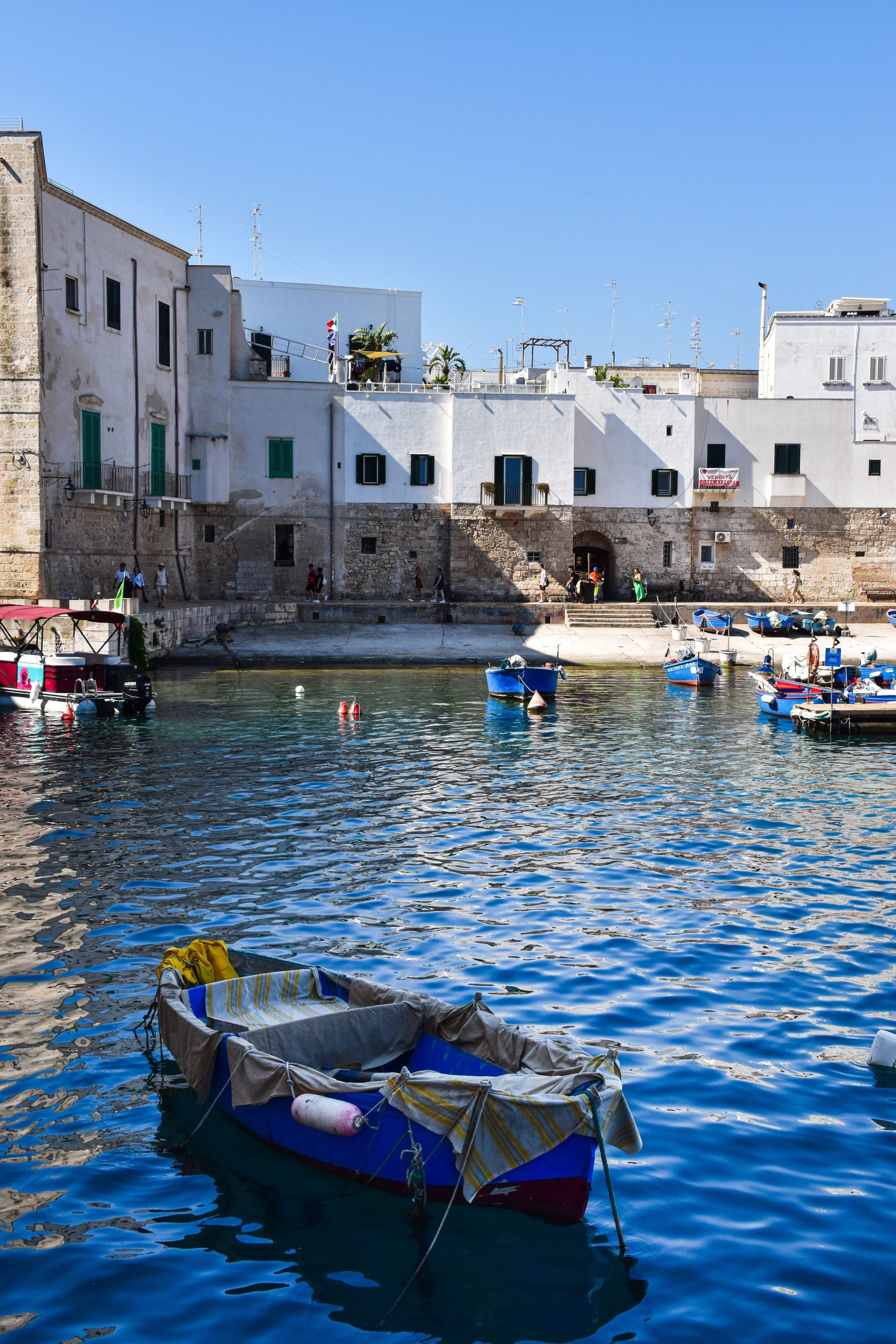
What to See in Otranto: History, Landmarks and Landscapes of a City Unlike Any Other in Puglia
Otranto does not announce itself. It appears suddenly, after kilometres of olive groves and narrow roads between dry-stone walls: white against the sea, its walls dropping straight to the harbour, the castle outlined against the blue of the Adriatic. It is one of the most beautiful cities in southern Italy, and perhaps one of the least appreciated for what it offers beyond the beach.
Staying in the Otranto area — in the countryside, in a masseria a few kilometres from the centre — means having this extraordinary city at hand: not for a rushed half-hour stop, but for a proper visit made at a pace that does it justice. Here is what not to miss, and how to plan your time.
The Old Town: Inside the Walls
The first thing to do on arriving in Otranto is to enter the historic centre, which unfolds entirely within a still-intact circuit of walls. Reinforced in the Aragonese period following the fall of the city in 1480, these walls enclose a labyrinth of narrow lanes, unexpected small squares, staircases that climb without warning, and sudden views over the sea.
The advice is not to follow a rigid route. Otranto reveals itself best at a slow pace — noticed through details: a Norman doorway, a courtyard with geraniums, a lane that opens onto a window of blue water. The city has a human scale that invites walking rather than ticking off a checklist.
The Cathedral: The Mosaic That Maps the World
The Cathedral of Otranto is one of the most extraordinary monuments in Italy — and one of the most underrated. Built by the Normans in the eleventh century and enlarged in subsequent centuries, it contains the largest medieval mosaic floor in Europe: one hundred and twenty-eight square metres of polychrome tiles covering the entire central nave.
The mosaic, completed in 1163 by the monk Pantaleone, is a visual encyclopaedia of the twelfth-century world. Biblical scenes, mythological figures, fantastical animals, kings and peasants, episodes from the Old and New Testaments interwoven with the medieval bestiary: a reading that could last hours. In the crypt beneath the nave lie the remains of the Eight Hundred Martyrs of Otranto, killed by the Ottomans in 1480 after refusing to renounce their Christian faith — one of the most dramatic episodes in the history of this coast.
The Aragonese Castle
Built by the Aragonese after the recapture of the city in 1481, Otranto Castle is one of the best-preserved coastal fortresses in southern Italy. Its pentagonal plan with circular bastions at each corner is a textbook example of Renaissance military architecture designed to withstand artillery — a direct response to the tragic lesson of the Ottoman siege.
Today the castle hosts temporary exhibitions and cultural events throughout the summer season. It is worth climbing onto the walls for the view over the harbour and the coast: from here it becomes immediately clear why Otranto was considered the gateway to the East, the point of Italy closest to Albania and Greece.
The Harbour and the Seafront
The harbour of Otranto is one of the city's most pleasant and lively spaces. Not an industrial port, but a relatively small mooring — fishing boats, a few pleasure craft — surrounded by bars, fish restaurants and terraces overlooking the water. The walk along the seafront, from the quay to the beach that opens northward, is a classic of any day spent in Otranto.
At sunset, the light on the Adriatic here is something difficult to describe: the sky turns orange and pink, the boats rock on calm water, and the city stops being a historic site for a moment and becomes simply a beautiful place to be.
Capo d'Otranto and the Torre di Sant'Emiliano
A few kilometres from the centre, Capo d'Otranto is the easternmost point of Italy: the first place on the peninsula to see the sun rise each morning. The limestone cliff drops sheer into the sea, Mediterranean scrub clings to the rocks, and on days of exceptional visibility the outline of Albania is visible on the horizon.
On the summit of the headland stands the Torre di Sant'Emiliano, one of the sixteenth-century coastal watchtowers built along the entire Apulian shoreline as a system of early warning against raids from the sea. The landscape here is among the most evocative on the entire Adriatic coast of Salento: limestone, scrub, open sea and a light that shifts continuously through the hours of the day.
Porto Badisco and the Grotta dei Cervi
Continuing south, about ten kilometres from Otranto, lies Porto Badisco: a small natural bay enclosed between high cliffs, identified by tradition as the place where Aeneas landed after fleeing Troy. Regardless of the legend, it is one of the most beautiful stretches of coastline on the peninsula.
Nearby is the Grotta dei Cervi — the Cave of Deer — discovered in 1970 and considered one of the most important prehistoric rock art sites in Europe. Its walls are covered with more than three thousand figures painted in red ochre and bat guano, dating from a period spanning the Palaeolithic to the Neolithic. The cave itself is not open to the public, but casts and documentation are held at the National Museum in Lecce.
Planning Your Visit: A Few Practical Notes
Otranto is best visited in the early morning or late afternoon, when the light is gentler and the old town less crowded. In high season — July and August above all — the city fills rapidly: arriving before nine in the morning makes a considerable difference.
Parking is available outside the walls, a short walk from the historic centre. The heart of the city is almost entirely pedestrianised: comfortable shoes are essential, given the cobblestones and the stepped lanes of the old town.
A thorough visit — old town, cathedral, castle, harbour and a walk to Capo d'Otranto — requires a full half-day. Adding Porto Badisco or a stop at the beach means planning for an entire day.
Otranto as a Base: The Advantage of Staying Nearby
One of the advantages of choosing accommodation in the Otranto countryside — rather than in the city itself — is the ability to visit the centre at the best hours of the day and return to a quieter, more natural setting when the day is over.
Masseria Panareo is positioned on the Otranto coastline, within easy reach of the old town, the beaches and the panoramic points of Capo d'Otranto. A comfortable and unhurried base from which to explore Otranto and the surrounding territory — and to which to return in the evening with the slower rhythm that this corner of Puglia, once you let it, tends to impose.